
Dr. Alton, United States: Enabling technology meets OR optimization for sustainable throughput increase
Dr. Timothy Alton is an experienced orthopedic surgeon specializing in total hip and knee replacements. Known for his interest in enabling technologies, including navigation-assisted hip procedures and robot-assisted knee surgery, Dr. Alton brings both clinical precision and a systems mindset to the operating room.
As his surgery center practice continued to grow, he was looking for a way to increase case volume without compromising the quality of care his team is known for. Growing OR throughput sustainably, with the same high standards and without burning out his team, was the goal.
The opportunity
Dr. Alton was already running efficient, high-volume days with some of the best enabling technology available. He wanted to make sure the workflows surrounding those tools were just as strong. With a growing patient pipeline and a limited surgical block, he saw an opportunity to increase OR throughput within the time he already had and DEO.care offered exactly that.
The approach
The DEO.care team began with a detailed baseline measurement of Dr. Alton's OR workflow, capturing the real-world rhythm of his surgical day. This data was then used to build a digital twin simulation, a model of how the OR system behaved under actual clinical conditions.
The simulation revealed clear opportunities to improve the workflow, which DEO.care translated into a detailed roadmap of targeted change modules. These were shared with Dr. Alton and his OR team in a collaborative workshop where everyone weighed in, before the OR team put the changes into practice. The adjustments focused on reducing idle time, running steps in parallel, and tightening communication and coordination across the team.

The results
The workflow changes translated directly into OR performance, with results across every dimension of the surgical day for both robot-assisted knee and navigated hip procedures:
OR time was reduced by an average of 15 minutes for navigated hip procedures and 27 minutes for robot-assisted knee procedures.
Average turnover time between cases fell from 34 minutes to 15 minutes, a saving of 19 minutes per case.
Workflow consistency improved significantly across all procedure types, with case time variability reducing from 61 minutes to 19 minutes.
Combined, these gains enabled Dr. Alton’s team to complete 10 cases in approximately 8 hours, around 2.5 hours less than the previous baseline.
The same 10.5-hour block represents the potential to accommodate up to 13 cases, 3 more than before.
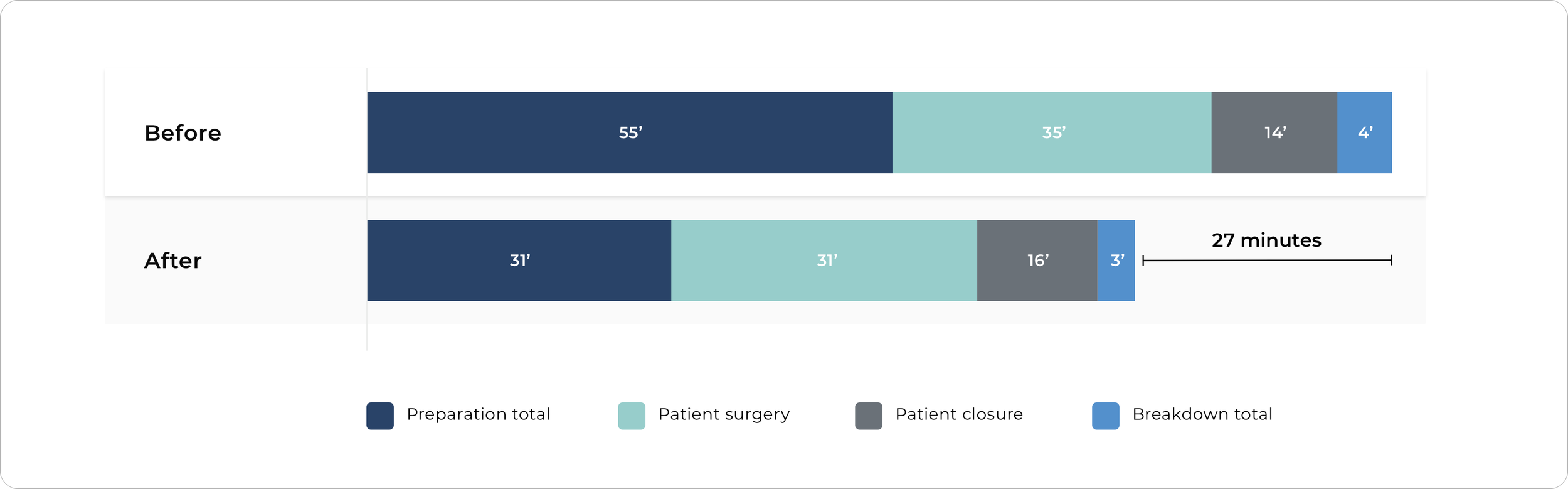
For robotic total knee replacement procedures, the average OR time per case reduced by 27 minutes, with the main improvements occuring during the procedure preparation phase.
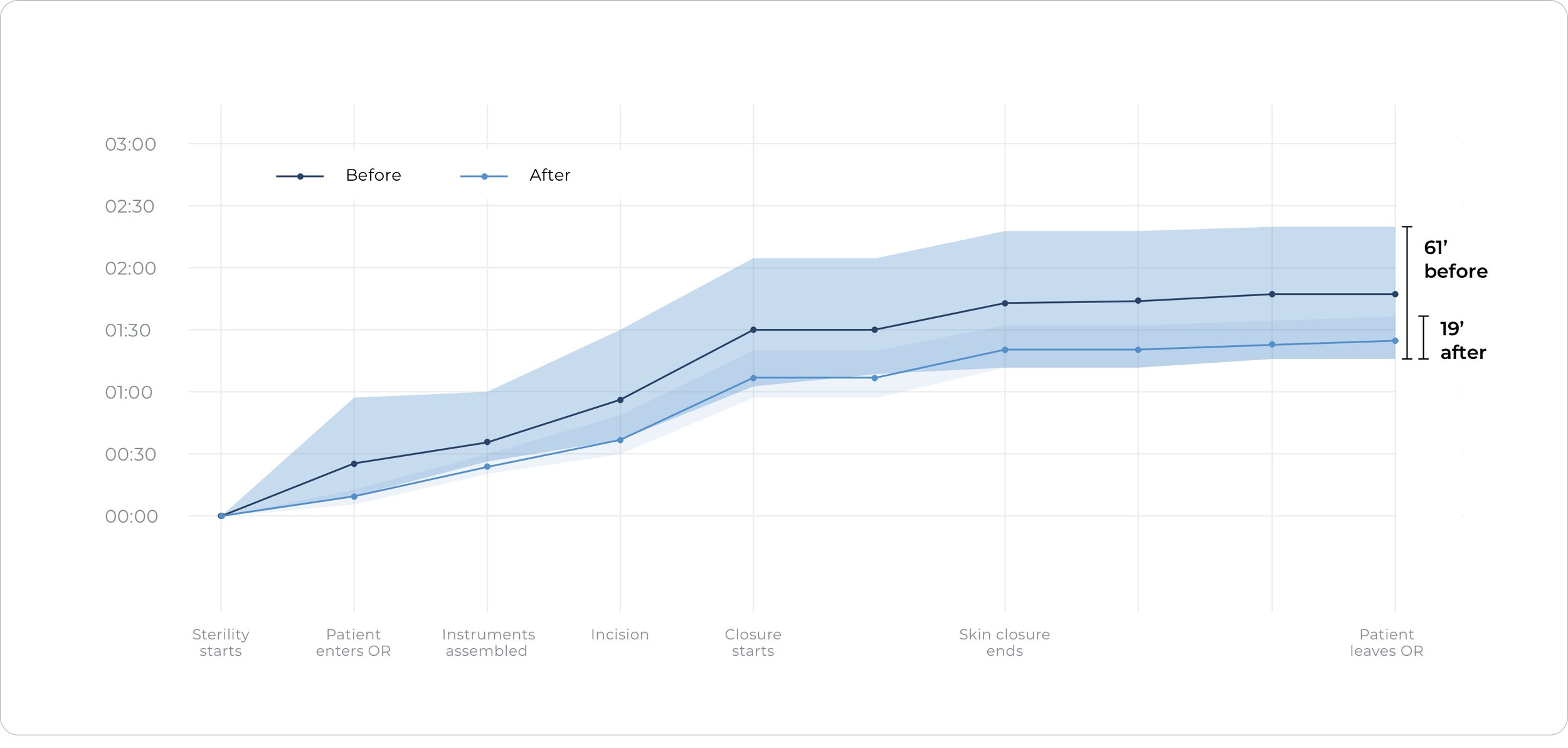
Workflow consistency was greatly improved with variability of procedure times shifting from 61 minutes to 19 minutes as a result of workflow standardization.
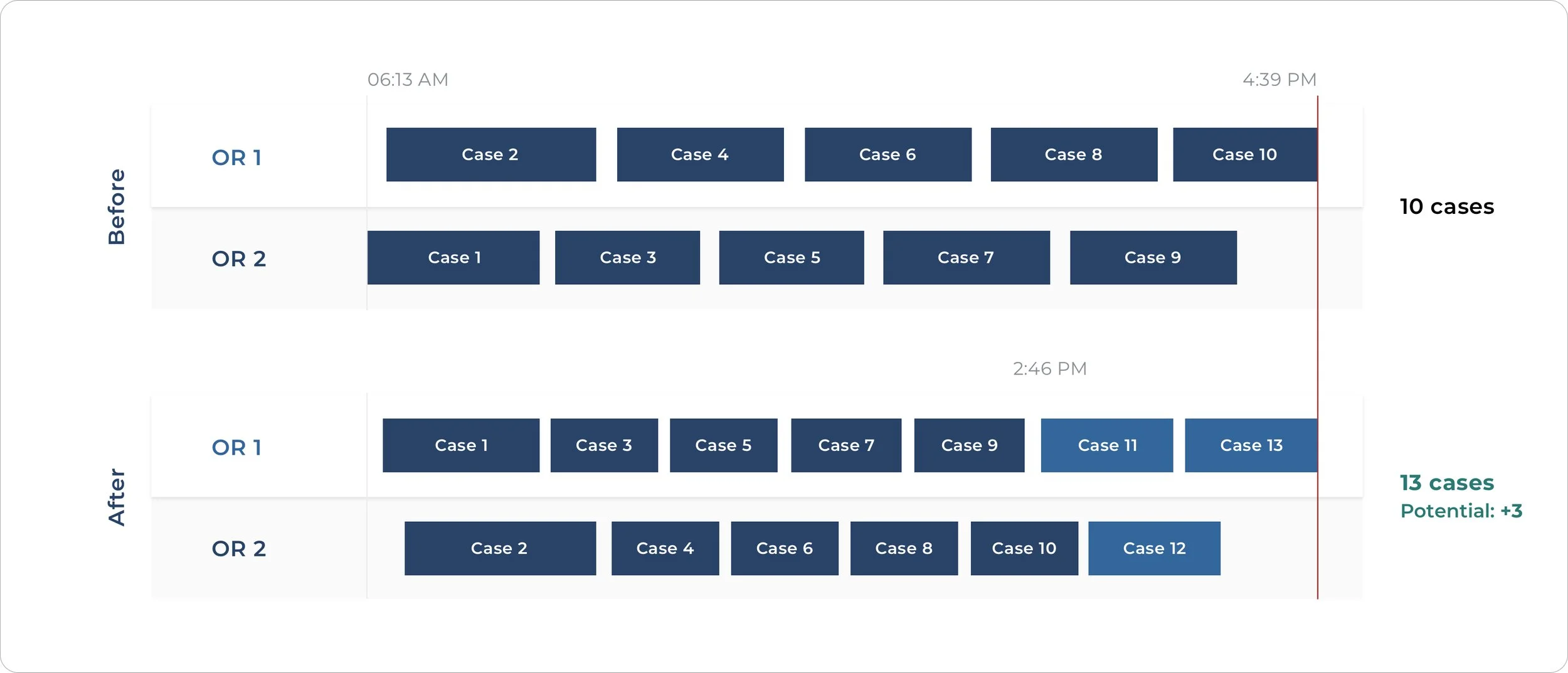
The improvements reduced the average OR time and day, enabling a potential of 3 additional cases to be scheduled in the same block.
With these improvements in place, Dr. Alton’s standard practice is now to complete 11 cases in a 9-hour block across two rooms. A 10-case day became an 11-case day, achieved not by working harder, but by working smarter. Looking ahead, he anticipates adding more cases to his day by leaning into these improvements.
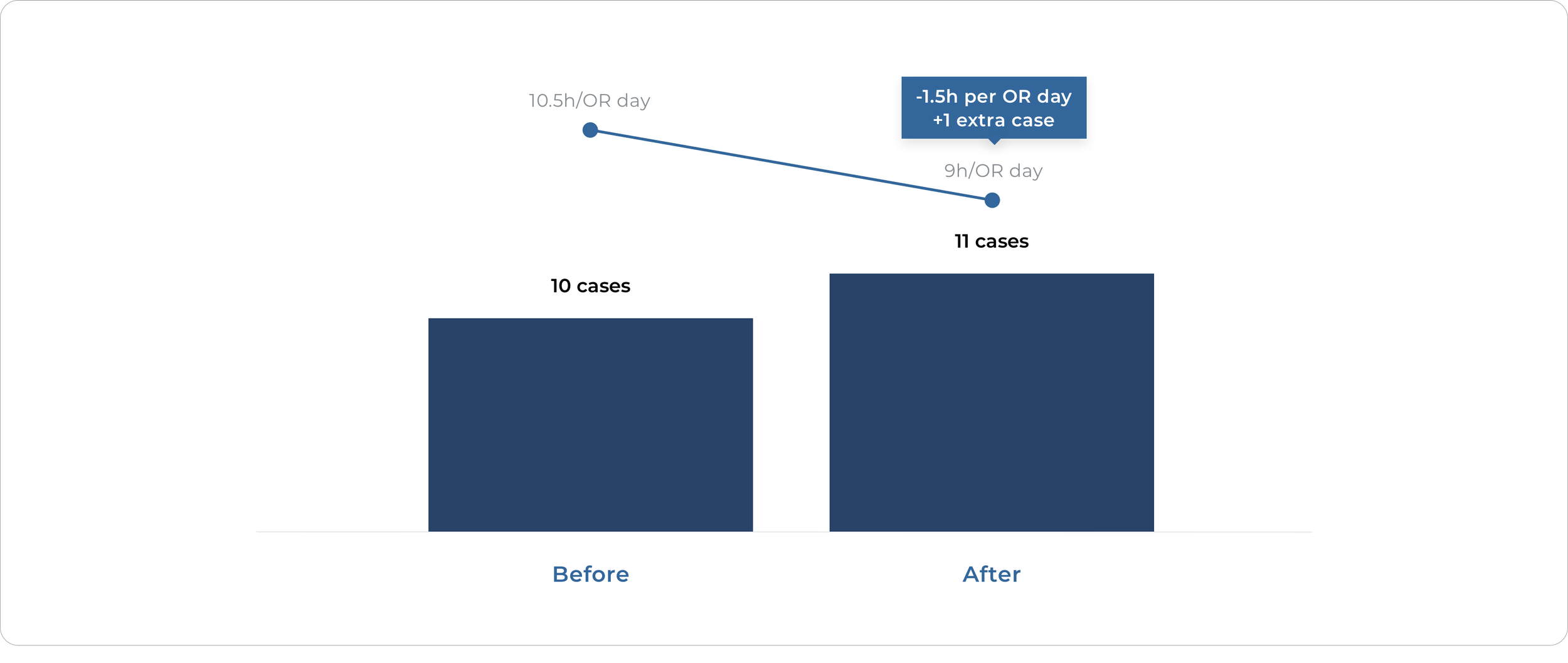
Following workflow improvements with DEO.care, Dr. Alton now regularly schedules a 9 hour OR block to complete 11 cases in two rooms.
For a team already working with robot-assisted knee replacements and navigation-assisted hip procedures, the process optimization ensured the precision of those tools extended to the entire surgical day. The team has embraced a day that is both higher in volume and shorter in duration, with the standardized workflow bringing greater clarity and confidence, delivering the dual outcome of improved financial performance and team satisfaction.
Enabling technology and OR optimization: a powerful combination
Enabling technologies like surgical navigation and robotics have transformed what is possible in the OR. But the full value of these tools is only realized when the workflows around them are equally well designed. Pairing enabling technology with rigorous OR optimization ensures that the precision inside the procedure extends to the entire surgical day
Key Takeaways
Robot-assisted knee replacements and navigation-assisted hip procedures established the clinical foundation; structured implementation extended that value to the entire day.
High-resolution baseline measurement of a complex, enabling technology-driven OR revealed specific, quantifiable opportunities for workflow improvement.
Digital twin simulation translated workflow data into a targeted change roadmap.
A collaborative team workshop drove alignment and enabled a seamless transition to structured execution.
One additional case is consistently being scheduled in a shorter block, with OR time reduced by up to 27 minutes per procedure and turnover cut by 19 minutes.
A foundation for sustained, compounding improvement, with increased team confidence and improved financial performance.