
Mr. Reshid Berber and Mr. Ben Bloch, Nottingham, UK: Sustaining five robotic knee replacements a day in an NHS operating room
Mr. Reshid Berber and Mr. Ben Bloch have a strong track record in robotic-assisted joint replacement. Mr. Bloch was the first surgeon in the UK to perform a total knee replacement using a new robotic-assisted joint replacement solution. Nottingham University Hospitals NHS Trust was also the first Trust in the region to introduce the technology into its operating rooms.
Both surgeons have since performed world-first cases using the platform's latest planning software, and both are well-recognized faculty members on international teaching courses.
However, less visible is the operational performance behind their work. Each surgeon runs five robotic-assisted knee procedures a day in a single NHS operating room. They do so consistently and predictably, while also teaching and welcoming visitation activities.
Reaching five cases once is an achievement. Making it the established rhythm of an operating room schedule requires every part of the day to work together.
This matters in an NHS environment where elective orthopedic services remain under pressure. A five-case schedule that runs consistently, and leaves room for teaching shows what a mature robotic knee program can achieve within a public health system.
Seeing the operating room process through a digital twin
Mr. Berber and Mr. Bloch had already developed highly effective ways of running their OR day. However, the two workflows had evolved independently. The practices supporting their performance had not been mapped in enough detail to compare them or share them widely across the Trust.
Therefore, DEO.care carried out an in-depth analysis of both surgeons' operating room workflow. With high-resolution workflow data, DEO.care created a digital twin of each configuration. In other words, a detailed simulation of how the team, patient, materials, and robotic workstream move through the day.
The objectives were to:
Understand what allows two independently run operating rooms to reach this level of throughput and predictability in an NHS setting,
Identify where further consistency could be gained, and
Turn individual best practices into a shared operational blueprint.
Analyzing the data already revealed best practices that help both teams maintain five-case OR days. Some of these include:
A well-integrated robot preparation flow to ensure robot readiness never becomes the limiting step.
A consistently timed patient preparation, supported by the on-time presence of the surgeon and fellow, and efficient disinfection and draping.
A streamlined instrument setup with only five instrument trays used for the entire procedure. This aligns with the best-performing workflows in DEO.care’s global benchmarking database.
Anesthesia is performed outside the OR through a highly standardized process to allow activities to progress in parallel.
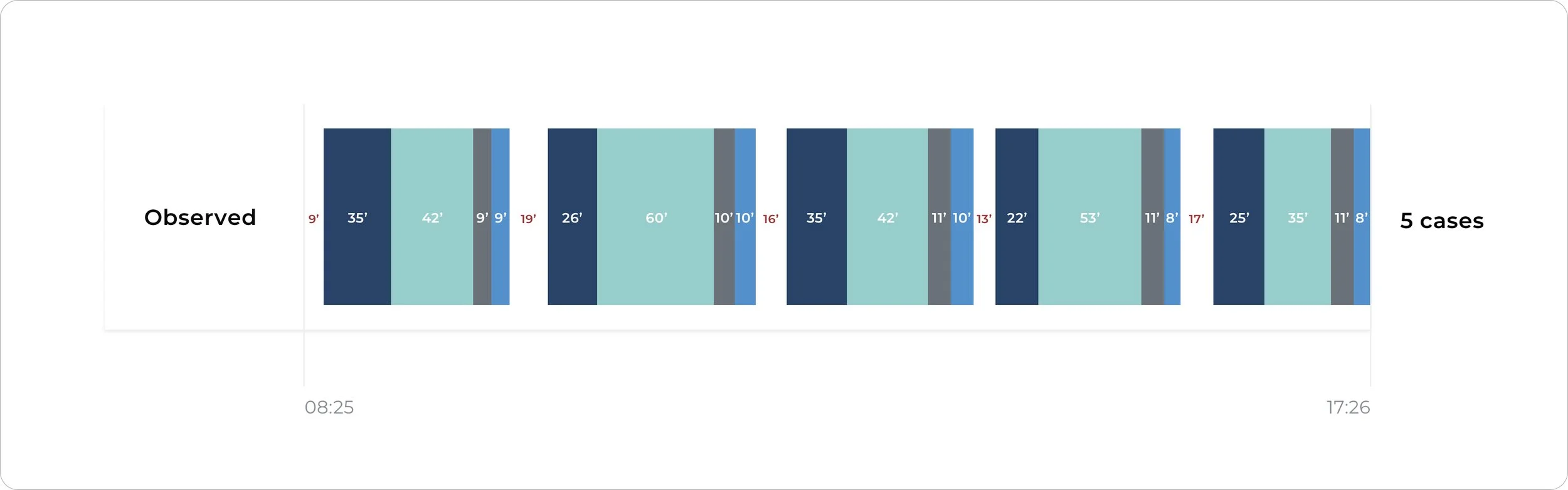
Together, these practices reduce idle time and help protect the rhythm of the schedule. No single step drives the five-case output; rather, coordination between steps keeps the OR day moving.
What benchmarking against the DEO.care database revealed
DEO.care benchmarked Nottingham's high-resolution workflow data against its global database for robotic-assisted knee replacement. The comparison confirmed that both OR schedules were already performing at a high level, but it also revealed a small number of opportunities to improve consistency and predictability even further:
On-time starts: A more consistent start to the first case would support a more predictable end-of-day finish time.
Room turnover: Turnover between cases currently takes longer and varies more than the pattern observed in DEO.care’s global benchmark database.
Communication and activity triggers: The teams already communicate well throughout the day. Agreeing on a few additional cues could help activities start earlier and make transitions between cases more efficient. For instance, signal when to begin preparing the next patient or setting up materials for the next procedure.
Patient and material preparation: The analysis found differences in the two surgeons’ workflows, mainly in material preparation and parallel patient tasks. Once visible, the differences provide clear opportunities for the teams to learn from each other.
At this level of performance, the remaining opportunities lie in how the team manages the minutes between established processes. Consider the timing of a hand-off, the start of the first case, or the point at which the next activity begins.
These details can be difficult to see during a busy OR day. Mapping the workflows and comparing them with benchmark data made them visible to both teams.
From individual best practices to a shared standard for the Trust
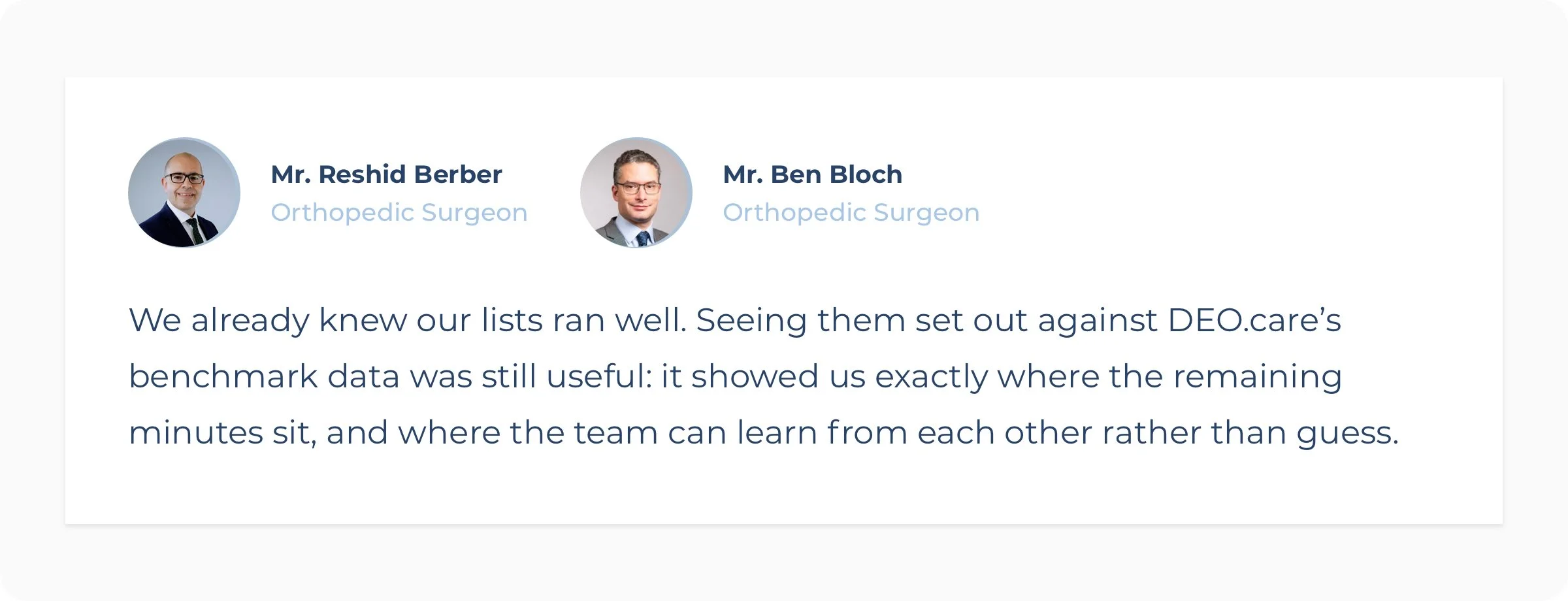
DEO.care's operating room process analysis is helping Mr. Berber and Mr. Bloch refine their individual workflows further and learn from each other. Instead of relying on instinct alone, they can compare the data and see what works best for both teams.
However, the value extends beyond the two surgeons. Nottingham University Hospitals NHS Trust now has a detailed blueprint of how two high-performing robotic knee schedules operate. This gives a data-driven foundation for sharing best practices with colleagues and supporting more consistency across the department.
The process digital twin also creates a common reference for improvement. Now, teams can discuss changes to preparation, turnover, or activity triggers against the actual workflow. Before, such discussions would be based on individual perceptions of how the OR day runs.
Nottingham demonstrates how a mature robotic knee replacement program can support consistent elective throughput in an NHS setting. They do not achieve five procedures a day through a single shortcut or by asking the team to work harder. Behind such high-performing teams are well-coordinated workflows, streamlined instruments, parallel preparation, and clearly timed activities.
By making these practices visible, DEO.care helps Nottingham turn two surgeons’ performance into a shared, repeatable operating room standard.
Public sources consulted: nuh.nhs.uk (NUH news, “Nottingham hospitals first in region to use knee replacement robot”); mrbloch.com; circlehealthgroup.co.uk consultant profiles for Reshid Berber and Benjamin Bloch; researchgate.net profile for Benjamin Bloch.