
Dr. Javier López Valenciano, Spain: Building on a high-performing OR workflow in robotic-assisted knee surgery
Hospital de Manises was among the first centers in Spain to adopt robotic-assisted knee replacement surgery. It was selected as one of two centers nationally to lead the rollout of the technique, reflecting its role in surgical innovation.
Alongside this early adoption, the team has established a highly consistent operating room workflow. Clearly defined roles and standardized processes help the team maintain a high-volume schedule.
Understanding the OR workflow through a digital twin
DEO.care carried out an in-depth analysis of Hospital de Manises's OR processes. Using in-person observation, it built a process digital twin: a simulation of the team's actual workflow configuration.
The data analysis confirmed highly standardized practices, with clear roles, responsibilities, and communication points guiding each stage of the day. The team worked consistently across preparation, skin-to-skin, closure, and breakdown, with little variation from case to case.
The analysis identified several best practices:
An efficient start to the day, supported by a well-organized robot preparation procedure.
Patient and material preparation are carried out in parallel.
Clear communication at key moments to help the team coordinate tasks and maintain a steady workflow.
These practices support a productive OR day. The team consistently completes three procedures in the morning and three in the afternoon without the day feeling rushed.
This established workflow provided a strong starting point for the analysis. The next step was to identify where further improvements could reduce workload and make better use of OR time.
Together, these practices reduce idle time and help protect the rhythm of the schedule. No single step drives the five-case output; rather, coordination between steps keeps the OR day moving.
What benchmarking against the DEO.care database revealed
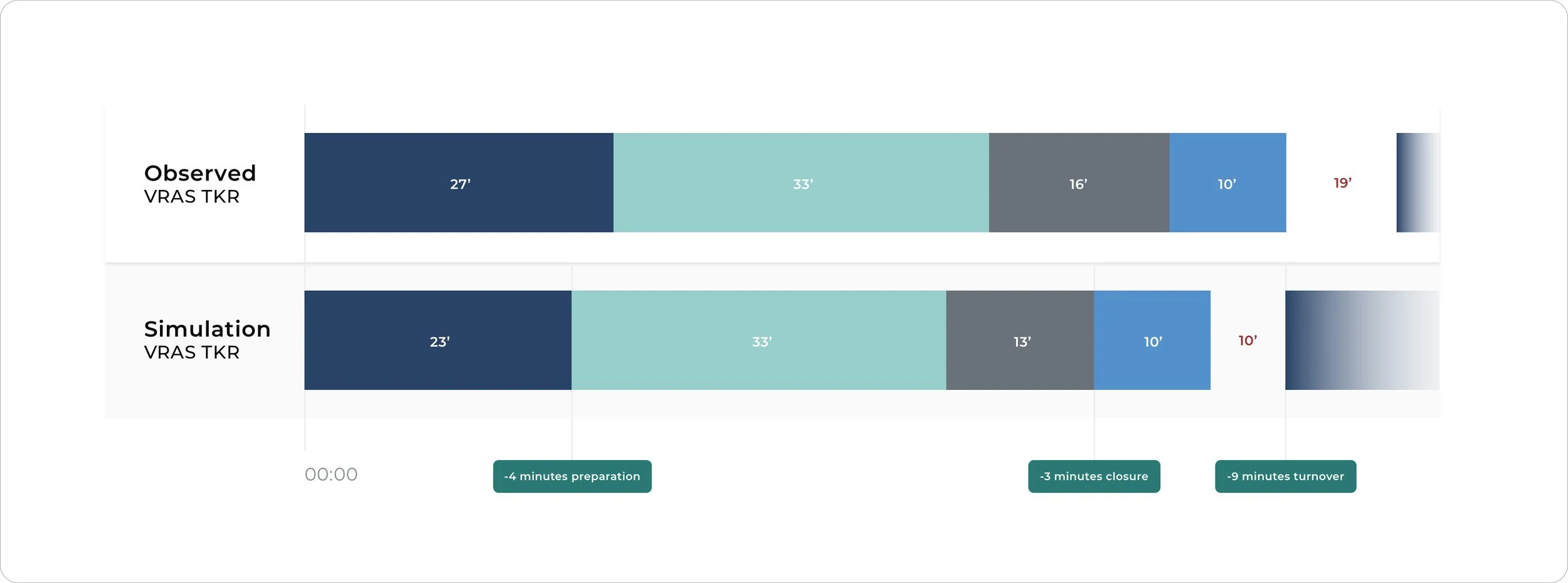
DEO.care compared Hospital de Manises' detailed workflow data with its best-practice database for robotic-assisted knee replacement surgery. Even with the team’s high level of consistency, the comparison identified opportunities for further improvement:
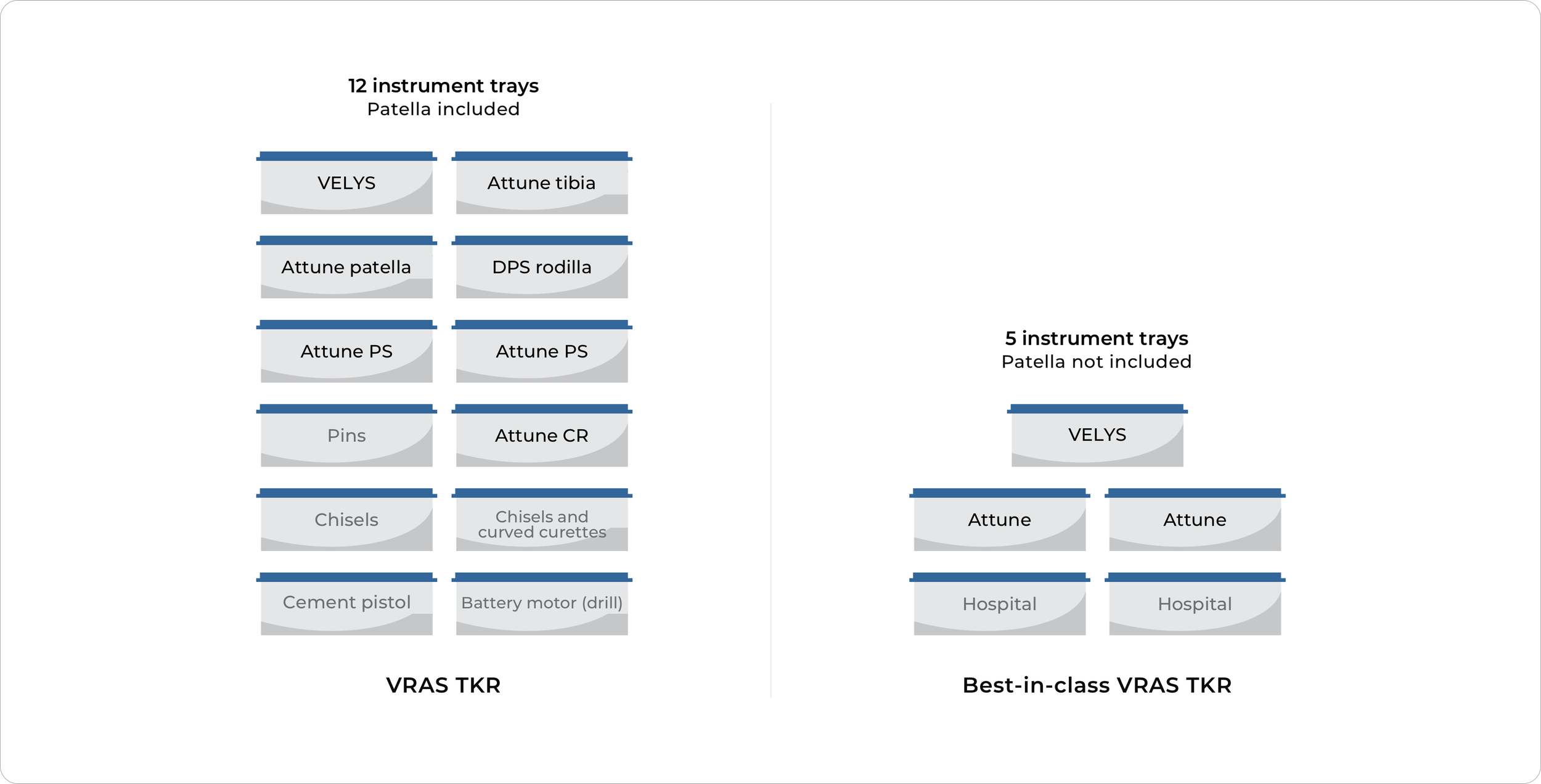
Instrument tray reduction: Hospital de Manises currently prepares 12 surgical trays per procedure. The best-performing hospitals in the benchmark use five. Reducing the number of trays could ease the team’s physical and mental workload and lower sterilization costs per procedure.
Shorter turnover time: Reducing the time between procedures could help the team finish the daily surgical schedule earlier and more reliably on time.
Less idle time during preparation: Reducing idle times between preparation tasks could help the team use OR time more efficiently.
Together, these opportunities could help shorten the OR day and reduce workload for the surgical team.
The goal: build on a program that already performs at a high level of consistency.
From reference site to continuous improvement built on a strong foundation
Hospital de Manises illustrates what a mature robotic-assisted knee surgery program can achieve through standardized roles, clear communication, and consistent execution across the day.
The DEO.care analysis builds on these strengths. It identifies specific opportunities to reduce instrument handling, idle time, and turnover. These improvements could reduce workload, shorten the day, and use available OR time more efficiently.
For a hospital already recognized for clinical and operational excellence, the analyis provides a clear path to further gains. Combining proven consistency with opportunities grounded in data is what continuous improvement looks like in practice.